![Blender Grinder – 3 in 1 [EMFB-3300]](https://electromax.pk/wp-content/uploads/2026/03/EMFB-3300-Ramadan.webp)
![Blender Grinder – 3 in 1 [EMFB-3300]](https://electromax.pk/wp-content/uploads/2025/05/EMFB-3300-1.jpg)
![Sandwich Maker [EMSM-703]](https://electromax.pk/wp-content/uploads/2025/08/EMSM-703-Ramadan.webp)
![Sandwich Maker [EMSM-703]](https://electromax.pk/wp-content/uploads/2025/05/EMSM-703.jpg)
![Electric Kettle [EMKT-2700]](https://electromax.pk/wp-content/uploads/2025/05/EMKT-2700-Ramadan.webp)
![Electric Kettle [EMKT-2700]](https://electromax.pk/wp-content/uploads/2025/05/EMKT-2700-2.jpg)
![Sun Heater [EMIH-1600]](https://electromax.pk/wp-content/uploads/2026/03/EMIH-1600-Ramadan.webp)
![Sun Heater [EMIH-1600]](https://electromax.pk/wp-content/uploads/2025/05/EMIH-1600-1.jpg)
![Vacuum Cleaner [EMVC-2500]](https://electromax.pk/wp-content/uploads/2026/03/EMVC-2500-Ramadan.webp)
![Vacuum Cleaner [EMVC-2500]](https://electromax.pk/wp-content/uploads/2026/03/EMVC-2500B-Ramadan.webp)
![Heavy Weight Dry Iron [EMDI-7600]](https://electromax.pk/wp-content/uploads/2026/03/EMDI-7600-Ramadan.webp)
![Heavy Weight Dry Iron [EMDI-7600]](https://electromax.pk/wp-content/uploads/2025/05/EMDI-7600-1.jpg)
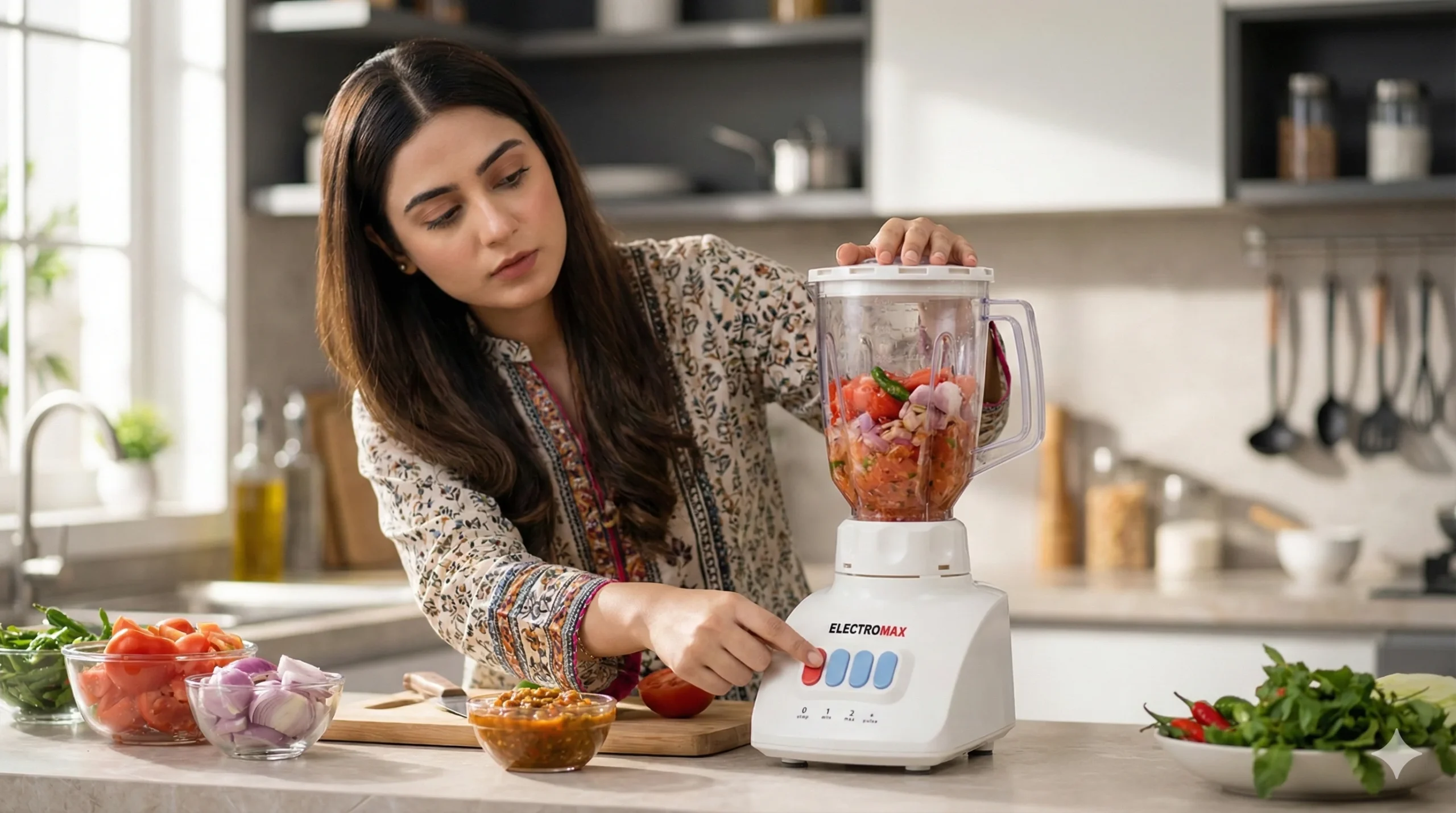
Pulse mode is one of the most underrated features in a blender grinder—especially in Pakistani kitchens where we need texture control for chutneys, masalas, and small-batch grinding. Used correctly, pulse helps you get the exact consistency you want, reduces unnecessary heat build-up, and improves control when ingredients aren’t circulating properly.
Explore Electromax Blenders & Grinders to compare models that offer speed control and pulse for everyday use.
Quick Answer: What pulse mode is best for
Use pulse mode for dry grinding (masala/spices), coarse chutneys, small batches, and whenever ingredients need help circulating into the blades. Avoid continuous pulsing for long smoothie blends or when you need a very smooth finish—steady blending on the right speed is usually better. Pulse is about short bursts + control, not running the machine longer.
What is pulse mode?
Pulse mode runs the motor in short bursts only while you press/hold the pulse control. This gives you quick spikes of power and immediate stopping, which is ideal when you want coarse texture or need to avoid over-processing.
When you SHOULD use pulse mode
1) Dry spice grinding (masala)
Dry spices can heat up quickly if you grind continuously. Pulse helps you grind in controlled bursts, improving texture and helping preserve aroma.
2) Coarse chutneys (dhaniya–podina, garlic chutney)
If you want “restaurant-style” chutney texture (not watery paste), pulsing helps you stop at the right point.
3) Small-batch grinding
Small quantities often stick to the sides and don’t drop into the blades. Pulse + short stops allows you to scrape and re-position ingredients for more even results.
4) Breaking down hard ingredients before blending
If you’re blending thicker mixtures or tougher ingredients, a few pulses can break down pieces first—then you can switch to steady blending.
When you should NOT rely on pulse mode
- Long smoothie or lassi sessions: use a steady speed for smoother results.
- When you want a very smooth puree: pulse can leave uneven texture unless you finish with steady blending.
- When the jar is already circulating well: continuous pulsing adds wear without adding benefit.
Pulse vs continuous blending (quick comparison)
| Task | Best approach | Why |
|---|---|---|
| Dry masala / spices | Pulse + short cycles | Better control, less heat build-up, more even grinding |
| Green chutney (coarse) | Pulse | Stops you from turning it watery |
| Green chutney (smooth) | Pulse, then steady blend | Pulse breaks down; steady blending finishes smooth |
| Smoothies / lassi | Steady blend | Consistent circulation and smoother texture |
| Small batches sticking to sides | Pulse + scrape | Helps reposition ingredients for even results |
The “right way” to use pulse (step-by-step)
- Start with 3–5 pulses: short bursts to break ingredients.
- Pause 2–3 seconds: let ingredients settle and reduce heat build-up.
- Check texture: stop early if you want coarse consistency.
- Scrape if needed: for small batches, scrape sides and pulse again.
- Finish appropriately: if you need a smooth result, switch to steady blending for a short finish.
Common pulse mistakes (avoid these)
- Holding pulse too long: pulse should be short bursts, not a replacement for steady blending.
- Overfilling the jar: overloaded jars reduce circulation and make pulse less effective.
- Grinding continuously without pauses: pauses help protect aroma and reduce heat build-up.
- Expecting pulse alone to create “smooth” results: smooth textures often need steady blending to finish.
Electromax models with pulse mode (direct links)
If pulse is a priority for chutney and masala, these Electromax options are worth shortlisting:
- Blender Grinder – 2 in 1 (EMFB-3100)
- Blender Grinder – 2 in 1 (EMFB-3200)
- Blender Grinder – 3 in 1 (EMFB-3300)
- Blender Grinder – 2 in 1 (EMFB-3500)
Related reading (recommended)
- Add link: Blender Grinder Buying Guide in Pakistan (Pillar)
- Add link: Best Blender Grinder for Chutney
- Add link: Blender Grinder for Masala & Dry Spices
- Add link: Blender Grinder Wattage Guide
FAQs
1) Is pulse mode necessary in a blender grinder?
For Pakistani cooking, it’s highly recommended. Pulse gives better control for chutneys, masala, and small-batch grinding.
2) How many pulses should I use for masala?
Start with 6–10 quick pulses, then use short cycles with pauses. Stop once you reach the texture you want—don’t grind longer than necessary.
3) Why does pulsing help prevent burnt smell during grinding?
Pulsing with pauses reduces continuous heat build-up, which helps protect spice aroma and avoids over-processing.
4) Can I make smoothies using only pulse mode?
You can start with a few pulses to break down ingredients, but for smooth texture, steady blending is usually better.
5) What else should I check besides pulse?
Prioritize 2-speed control, stainless steel blades, a stable base (non-slip feet), and safe locking for better daily usability.
Final recommendation
Pulse mode is your best tool for control—especially for chutney texture and dry masala grinding. Use short bursts, pause to manage heat, and switch to steady blending when you want a smooth finish. If these are your daily use-cases, shortlist a blender grinder that offers pulse and practical stability features.
Ready to choose? Browse Electromax Blenders & Grinders to compare models.
Electromax — We Deliver Innovation.