![Blender Grinder – 3 in 1 [EMFB-3300]](https://electromax.pk/wp-content/uploads/2026/03/EMFB-3300-Ramadan.webp)
![Blender Grinder – 3 in 1 [EMFB-3300]](https://electromax.pk/wp-content/uploads/2025/05/EMFB-3300-1.jpg)
![Sandwich Maker [EMSM-703]](https://electromax.pk/wp-content/uploads/2025/08/EMSM-703-Ramadan.webp)
![Sandwich Maker [EMSM-703]](https://electromax.pk/wp-content/uploads/2025/05/EMSM-703.jpg)
![Electric Kettle [EMKT-2700]](https://electromax.pk/wp-content/uploads/2025/05/EMKT-2700-Ramadan.webp)
![Electric Kettle [EMKT-2700]](https://electromax.pk/wp-content/uploads/2025/05/EMKT-2700-2.jpg)
![Sun Heater [EMIH-1600]](https://electromax.pk/wp-content/uploads/2026/03/EMIH-1600-Ramadan.webp)
![Sun Heater [EMIH-1600]](https://electromax.pk/wp-content/uploads/2025/05/EMIH-1600-1.jpg)
![Vacuum Cleaner [EMVC-2500]](https://electromax.pk/wp-content/uploads/2026/03/EMVC-2500-Ramadan.webp)
![Vacuum Cleaner [EMVC-2500]](https://electromax.pk/wp-content/uploads/2026/03/EMVC-2500B-Ramadan.webp)
![Heavy Weight Dry Iron [EMDI-7600]](https://electromax.pk/wp-content/uploads/2026/03/EMDI-7600-Ramadan.webp)
![Heavy Weight Dry Iron [EMDI-7600]](https://electromax.pk/wp-content/uploads/2025/05/EMDI-7600-1.jpg)
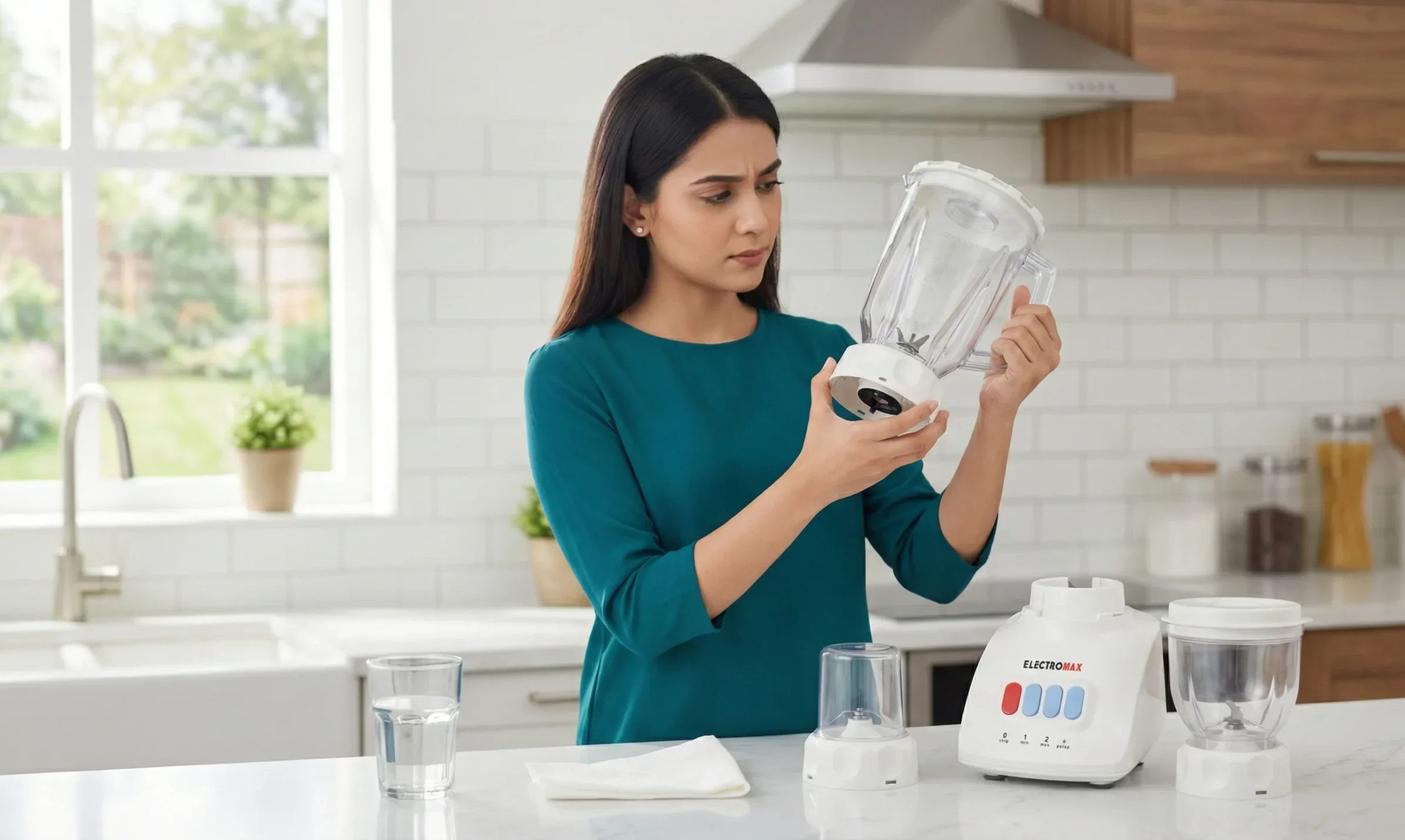
A leaking blender jar is more than a mess; it can damage the motor base if liquid runs downward. The good news: most leaks come from a small set of causes (seal/gasket wear, loose blade/base assembly, lid seating, or a hairline crack) and can often be fixed with a structured check.
For daily-use options built with stability and secure-lid features, browse Electromax Blenders & Grinders.
Quick Answer: How to stop a blender jar leak fast
First locate the leak source: lid/rim, jar wall, or bottom/blade area. Then: (1) re-seat and tighten the lid/base correctly, (2) clean the seal/gasket surfaces, and (3) inspect the gasket/O-ring for flattening, cracks, or looseness—replace if worn. If the jar is cracked, replacement is usually the only reliable fix. If the leak is coming from the base area and persists, stop using it until the seal/blade assembly issue is resolved.
Step 1: Identify WHERE it’s leaking (this matters)
| Leak location | What it usually indicates | Best first fix |
|---|---|---|
| From lid/rim | Lid not seated, seal dirty, overfilling/foaming | Re-seat lid, clean lid seal, reduce fill level |
| Inspect closely; replace the jar if cracked | Hairline crack or damage | Inspect closely; replace jar if cracked |
| From the jar wall | Loose base/blade assembly, worn gasket/O-ring | Tighten base; inspect & replace gasket if needed |
Why this is important: a bottom leak is often tied to gasket or blade assembly issues; many troubleshooting guides recommend tightening the base first, then inspecting/replacing the gasket if tightening doesn’t solve it.
Step 2: Do the “60-second leak test”
- Unplug the base.
- Fill with plain water (below the max line if marked; otherwise, keep it conservative).
- Place the jar on a dry paper towel for 2–3 minutes.
- Look for the first wet spot (lid edge, jar wall, or bottom).
The 7 most common causes (and how to fix each)
1) Worn or damaged gasket / O-ring (most common)
If the gasket is loose, cracked, hardened, or flattened, liquid can pass through, especially at the bottom assembly. Many repair/troubleshooting resources point to gasket failure as a primary cause of bottom leaks and recommend replacement when worn.
2) Blade/base assembly is not tight
A common fix is simply tightening the bottom/base assembly properly. If it’s loose, liquid can seep through even if the gasket is okay. If tightening doesn’t solve it, inspect the gasket and replace if necessary.
3) Seal is dirty (residue on the sealing surface)
Even if you wash regularly, residue can accumulate where the lid or bottom seal sits. Cleaning the seal groove and seating surfaces can stop seepage.
4) Overfilling or foaming
When blending hot liquids, thick shakes, or foamy mixtures, pressure increases, and liquid can push past the lid. Reducethe fill level and use a lower speed/pulse to start.
5) Cross-threading / incorrect assembly
If the jar threads or the bottom assembly are not aligned correctly, it may “feel” tight but won’t seal. Reassemble carefully and confirm even seating.
6) Hairline crack in jar or base component
A micro-crack can leak only under vibration. Inspect under bright light. If cracked, replacement is usually the only dependable fix.
7) Persistent base leak
If the leak is consistently from the base area even after cleaning and proper tightening, treat it as a seal/assembly issue and stop using it until repaired. Manufacturers often recommend service/support for persistent base leaks.
Fix-by-symptom cheat sheet
| Symptom | Likely cause | Fix | When to replace |
|---|---|---|---|
| Leak from the bottom | Leak around the lid | Clean lid seal & groove; re-seat lid; reduce fill | If the crack is visible |
| Leak only during blending | Hairline crack or pressure/foam | Inspect jar; reduce load; start slow/pulse | If the gasket is cracked/flattened or leak persists |
| Leak from bottom | Loose base or worn gasket/O-ring | Tighten base; inspect & replace gasket | If the seal area stays wet from inside leakage |
| Drip after washing | Lid not seated / dirty seal/overfill | Dry fully; clean threads | Water trapped near the seal threads |
How to prevent leaks (simple habits)
- Clean the sealing surfaces (lid seal + base seal area) regularly—this prevents residue from breaking the seal.
- Don’t over-tighten threaded parts—over-tightening can deform seals and contribute to cracking over time.
- Don’t overfill especially with foamy or hot blends.
- Use pulse to start thick mixtures—this reduces sudden pressure and helps ingredients circulate.
Electromax options worth shortlisting (stability + secure lid features)
While any blender can leak if a seal is damaged, stability and secure-lid design help reduce day-to-day seepage and vibration-related issues:
- Blender Grinder – 2 in 1 (EMFB-3500) — highlights non-slip feet and a secure lid lock, plus a safety-focused design.
- Blender Grinder – 2 in 1 (EMFB-3100) — lists a safety lock system and non-slip rubber feet (useful for stable grinding).
- Blender Grinder – 2 in 1 (EMFB-3200) — lists non-slip feet and includes a separate mill attachment for dry grinding routines.
Related reading (add links once published)
- Add link: How to Clean a Blender Jar (Remove Smell, Stains, and Residue)
- Add link: Pulse Mode in a Blender Grinder (When to Use It)
- Add link: Blender Grinder for Masala & Dry Spices
- Add link: Blender Grinder Buying Guide in Pakistan (Pillar)
FAQs
1) Can a leaking blender jar be repaired?
Often, yes—especially if the issue is a loose assembly or a worn gasket/O-ring. Tightening the base and replacing a worn gasket are common solutions. If the jar is cracked, replacement is usually required.
2) Why does my blender leak only when it’s running?
Vibration and pressure can reveal hairline cracks or weak seals. Do the water + paper towel test and inspect the jar under bright light to locate the leak source.
3) Should I keep using the blender if it leaks from the bottom?
No. A bottom leak can run liquid toward the motor base. Stop using it until the gasket/blade assembly issue is resolved.
4) What should I check first: lid or gasket?
Check the leak location first. Lid/rim leaks are often a seating/cleaning/overfill issue. Bottom leaks are more often linked to gasket/O-ring or base/blade assembly problems.
5) How do I prevent leaks long-term?
Keep seals clean, avoid overfilling, assemble correctly (no cross-threading), and use pulse to start thick mixtures. Replace worn gaskets promptly.
Final recommendation
Fix blender leaks systematically: locate the leak, clean and re-seat seals, tighten assemblies, and replace worn gaskets/O-rings. If the jar is cracked or the base leak persists, stop using it until repaired or replaced—protecting the motor base is always the priority.
Looking for a daily-use blender grinder? Explore Electromax Blenders & Grinders.
Electromax — We Deliver Innovation.