
![Blender Grinder – 3 in 1 [EMFB-3300]](https://electromax.pk/wp-content/uploads/2026/03/EMFB-3300-Ramadan.webp)
![Blender Grinder – 3 in 1 [EMFB-3300]](https://electromax.pk/wp-content/uploads/2025/05/EMFB-3300-1.jpg)
![Sandwich Maker [EMSM-703]](https://electromax.pk/wp-content/uploads/2025/08/EMSM-703-Ramadan.webp)
![Sandwich Maker [EMSM-703]](https://electromax.pk/wp-content/uploads/2025/05/EMSM-703.jpg)
![Electric Kettle [EMKT-2700]](https://electromax.pk/wp-content/uploads/2025/05/EMKT-2700-Ramadan.webp)
![Electric Kettle [EMKT-2700]](https://electromax.pk/wp-content/uploads/2025/05/EMKT-2700-2.jpg)
![Sun Heater [EMIH-1600]](https://electromax.pk/wp-content/uploads/2026/03/EMIH-1600-Ramadan.webp)
![Sun Heater [EMIH-1600]](https://electromax.pk/wp-content/uploads/2025/05/EMIH-1600-1.jpg)
![Vacuum Cleaner [EMVC-2500]](https://electromax.pk/wp-content/uploads/2026/03/EMVC-2500-Ramadan.webp)
![Vacuum Cleaner [EMVC-2500]](https://electromax.pk/wp-content/uploads/2026/03/EMVC-2500B-Ramadan.webp)
![Heavy Weight Dry Iron [EMDI-7600]](https://electromax.pk/wp-content/uploads/2026/03/EMDI-7600-Ramadan.webp)
![Heavy Weight Dry Iron [EMDI-7600]](https://electromax.pk/wp-content/uploads/2025/05/EMDI-7600-1.jpg)
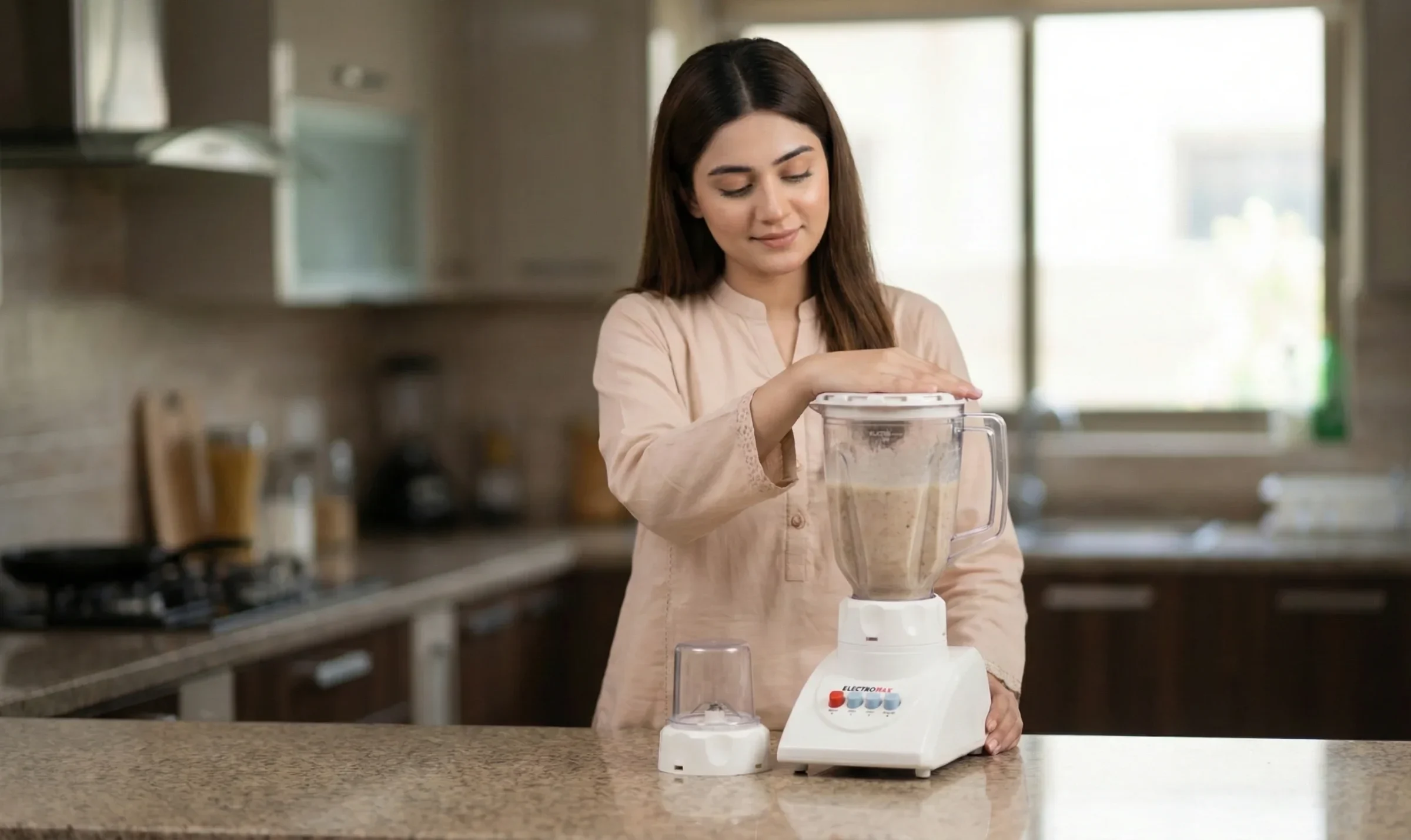
Blenders are naturally loud—but sudden new noise, excessive vibration, or “grinding/squeaking” sounds are usually a sign that something is off: placement, assembly, load, or wear in moving parts. The goal is simple: reduce vibration, protect the motor, and restore smooth operation.
For daily-use options designed with stability features, browse Electromax Blenders & Grinders.
Quick Answer: The fastest way to reduce blender noise
Start with the basics: place the blender on a solid, flat countertop (not on a cutting board), confirm the jar/assembly is seated correctly, reduce the load, and use pulse to start thick mixes. If you hear grinding or high-pitched squeaking, stop using it until you inspect the jar/blade/bearing area—those sounds can indicate wear that needs service. :contentReference[oaicite:0]{index=0}
Before troubleshooting: 3 safety rules
- Unplug before checking the blade/jar/base.
- Never run a leaking or sparking unit.
- If the sound is grinding/squeaking or there’s a burning smell, stop and inspect—don’t “push through it.” :contentReference[oaicite:1]{index=1}
Noise diagnosis table (match your symptom)
| What you hear/see | Most likely cause | Best first fix | When to stop & service |
|---|---|---|---|
| Shaking/vibrating on the counter | Unit not on a solid flat surface / unstable base | Move to a solid countertop (not a board/mat); level it | If still shaking after proper placement (feet/drive issues may exist) |
| Rattling or “loose” sound | Loose assembly / parts not seated | Re-seat jar, lid, and any threaded/base parts; tighten correctly | If rattling persists after correct assembly |
| Grinding sound | Wear in blade/bearing area | Stop and inspect jar/blade assembly; do not keep running | Grinding can indicate bearing breakdown—service recommended |
| High-pitched squeak | Bearing wear | Stop and inspect; contact support/service | Commonly treated as a service issue |
| “Thumping” / uneven blending noise | Load too thick / air pockets / ingredients not circulating | Add liquid gradually (if recipe allows); start with pulse; reduce batch size | If motor struggles repeatedly or smells hot |
The 7 most common reasons blenders get noisy (and fixes)
1) It’s on the wrong surface (the #1 vibration amplifier)
If the blender sits on a cutting board, tray, or flexible surface, vibration increases. Place it flat on a solid countertop. Some manufacturers explicitly recommend using a solid, fixed surface for shaking/vibration issues. :contentReference[oaicite:2]{index=2}
2) Jar/base assembly isn’t seated or aligned properly
Misalignment or improper assembly can create excess noise and vibration. Remove the jar, re-seat it, and ensure any coupling/connection is correctly aligned and secure. :contentReference[oaicite:3]{index=3}
3) Overloading (too much, too thick, too dry)
Thick mixtures can cause “thumping,” stalling, and loud strain. Fix it by reducing batch size, adding liquid slowly (where appropriate), and using pulse to start.
4) Ingredients aren’t circulating (air pocket / “cavitation”)
You’ll hear uneven blending and the contents “bounce.” Use pulse in short bursts, pause, scrape sides, and restart on a lower speed before increasing.
5) Loose lid or vibrating parts
A loose lid can rattle loudly. Re-seat the lid, confirm it’s locked, and avoid overfilling (pressure and splashes increase noise).
6) Worn blade bearing / seal (grinding or squeaking)
If you hear grinding or a high-pitched squeak, treat it seriously. Some manufacturer guidance notes these sounds can indicate the blade bearing assembly is breaking down and recommends service. :contentReference[oaicite:4]{index=4}
7) Feet/grip issues (unit “walks” on the counter)
If the blender moves during operation, stability features matter. If it still walks after moving to a solid surface, inspect the feet and base condition and avoid running heavy loads until resolved.
Practical “quieting” steps that don’t reduce performance
- Start thick blends with pulse for 3–5 short bursts, then move to steady blending.
- Use smaller batches for dry grinding and thick chutneys.
- Keep the jar and lid clean—residue around seals can prevent full seating and create rattles.
- Don’t use soft mats under the blender if they make the unit unstable (solid contact is usually better for vibration control). :contentReference[oaicite:5]{index=5}
Electromax picks if stability is a priority (direct links)
If you want reduced movement and steadier operation, prioritize models that highlight non-slip feet and secure locking features:
- Blender Grinder – 2 in 1 (EMFB-3500) — highlights non-slip feet / rubber feet and a secure lid lock, positioned for stability and reduced vibration. :contentReference[oaicite:6]{index=6}
- Blender Grinder – 2 in 1 (EMFB-3100) — highlights an automatic safety locking system and non-slip rubber feet to prevent movement during operation. :contentReference[oaicite:7]{index=7}
Related reading (add links once published)
- Add link: Blender Grinder Buying Guide in Pakistan (Pillar)
- Add link: Pulse Mode in a Blender Grinder (When to Use It)
- Add link: How to Clean a Blender Jar (Remove Smell, Stains, and Residue)
- Add link: Blender Jar Leaking? Causes & Fixes
FAQs
1) Is it normal for a blender to be loud?
Yes—high-speed motors are loud by design. What’s not normal is a sudden change: new grinding, squeaking, excessive vibration, or a burning smell.
2) Why does my blender shake so much?
Most often it’s placement (not flat/solid) or load (too thick/too much). Start by placing it on a solid countertop and reducing batch size. :contentReference[oaicite:8]{index=8}
3) What does a grinding sound mean?
A grinding sound can indicate wear around the blade bearing assembly. Stop using it and inspect/service as needed. :contentReference[oaicite:9]{index=9}
4) How do I reduce noise when blending thick mixtures?
Use pulse to start, add liquid gradually if your recipe allows, and blend in smaller batches. This improves circulation and reduces strain.
5) When should I stop using the blender immediately?
If you hear grinding or high-pitched squeaking, see leaks into the base area, notice sparks, or smell burning—stop and address the issue before running again. :contentReference[oaicite:10]{index=10}
Final recommendation
Most blender noise issues are solvable with the basics: solid surface, correct assembly, smaller batches, and pulse-first technique. If the noise is grinding or squeaking, treat it as a wear/service signal rather than a “normal” sound. For daily Pakistani cooking, choosing a blender grinder with non-slip feet and secure locking improves stability and reduces vibration over time.
Explore options: Electromax Blenders & Grinders
Electromax — We Deliver Innovation.